
Everything Wrong With the Star Wars Sequels Begins with The Force Awakens
A deep dive into the story mechanics of the film, and how broken they were

It was all to serve this one and only mandate that we had on this process, which was that we wanted to tell a story that would delight us and that would give us that spark, that feeling that you have when you watch Star Wars.1
I would never be one to insist that someone should dislike something. What you like is subject to a lot of different variables, and there is a lot to enjoy in the Star Wars sequels. They are designed to resonate with fans of the Original Trilogy, and anyone can identify with aspects of their presentation.
However, there are some serious issues in the craft of the story which ultimately leaves some viewers cold. There is something missing that may not be readily identifiable, but when you peel back the layers of fun and nostalgia, what remains may be a serviceable movie but it isn’t a very good Star Wars story.
This is not a wish list of what I think they should have done. This is the first of a three-part series examining the craft of storytelling and how poorly that craft was applied in the writing of these films.
Now, not everyone is a nerd about storytelling. Many fans of franchise films simply like to have a bit of fun and enjoy the spectacle, but storytelling issues can make people think: “Well, that’s not my Luke Skywalker.”
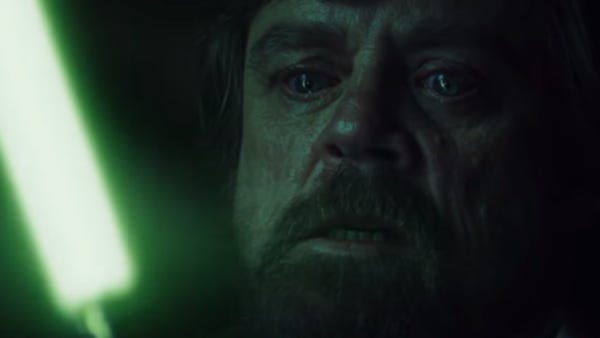
Which doesn’t really get to the heart of the problem. Telling a story is not as simple as introducing characters, having them go on an adventure, defeat a villain and having a happy ending. That might be enough for a bedtime story you tell to a six-year old whose imagination will fill in the necessary story gaps with their own interpretation of why things happen, but that’s really...just a plot sequence.
Basic Story Structure and Character Function
A story requires a main character with a clear weakness that is presently making their life difficult. They must have a goal to pursue and an opponent who stands in the way of that goal, representing an opposing value proposition or worldview. The protagonist develops a plan to defeat the opponent and achieve their goal, and they endure a try/fail cycle where they learn how to overcome their weakness in order to defeat the opponent. The conflict ultimately is resolved in a final confrontation, and the protagonist experiences a fundamental and permanent change as the world settles into a new normal.
Lawrence Kasdan is a highly-skilled screenwriter who is credited with a lot of what helped make the Empire Strikes Back the greatest Star Wars film ever made. Which is why the one character in The Force Awakens who has a clear weakness making their life difficult, who gains a clear goal to pursue, with an opponent who represents an opposing value proposition…is Han Solo. He started in one place, running from his responsibilities to a new place: pursuing and accepting his son. That’s a story.
The rest of The Force Awakens...doesn’t really have that.
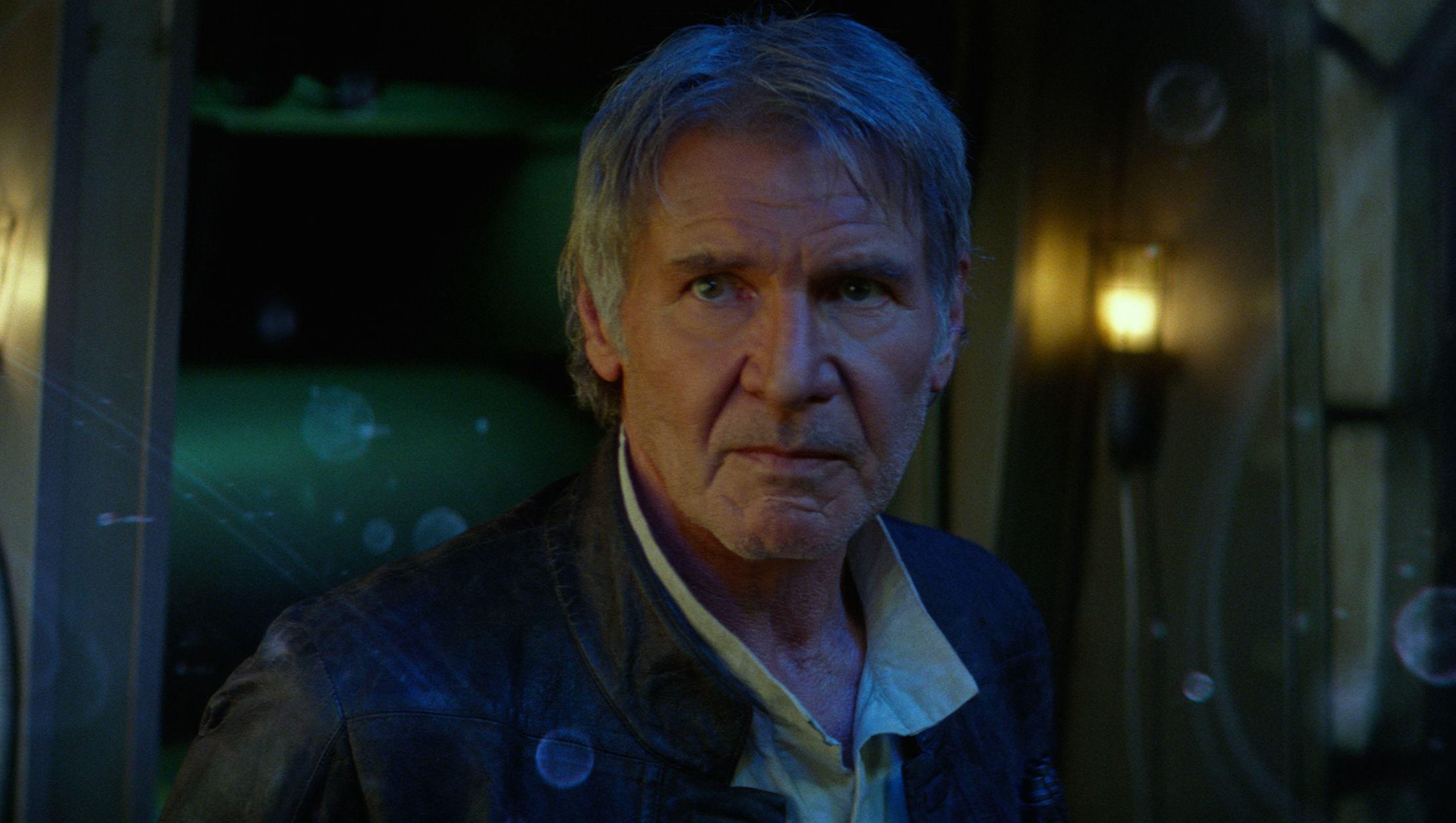
Those in charge of the new era of Lucasfilm decided that they needed three new heroes to take the torch from Luke, Han and Leia, except this is a misunderstanding of character function. George Lucas established one primary protagonist with two other supporting characters. That doesn’t mean Han Solo and Princess Leia weren’t heroic, but their character archetypes served the story of the hero.
Han Solo acted both as an ally to the Hero’s goal, delivering the droids to Alderaan, then rescuing the Princess, but also possessing his own goal: paying off his debts. He also presents a contrasting view to the Mentor, providing a philosophical and thematic conflict. Princess Leia is the ideal worth fighting for; the princess worth saving; the leader worth following. She is an ally in the escape from the Death Star, and a mentor when trying to encourage Luke before the Death Star battle.
Ultimately, all the characters serve different roles, and represent different things for the hero of the story. While George Lucas introduces the character of Princess Leia first, it is not to establish this character and the stakes for her, it is to establish the stakes for the world of the story. When Luke receives the Call to Adventure, the viewer must understand what Luke is getting himself into, even if he doesn’t.
Abandoning Story Basics for Nostalgia
The opening scene of The Force Awakens echoes the opening scene of Star Wars and establishes the stakes for the world of the story. The map to Luke Skywalker’s location stands in for the plans to the Death Star. Kylo Ren is the villain. Poe Dameron is the noble leader who is captured but manages to hide the Death Star plans in a—
Sorry, the map to Luke Skywalker...
...in a droid who runs off into the desert. The villain wants to know what the Princess has done with—
Sorry, what the pilot has done with the plans—
Sorry again, I mean the map.
We are led to believe the only thing that can save the galaxy is finding Luke Skywalker (more on this later). However, why do we have stormtroopers again? Why do we have another black-costumed mask-wearing, red lightsaber-wielding, voice-altered villain again? It isn’t that the worldbuilding here is achieved more poorly than in Star Wars; after all, Lucas didn’t need to tell us why the Empire existed because it was the beginning of the story.
But The Force Awakens is not the beginning of the story.
Instead of returning to the equilibrium established at the end of Return of the Jedi—you know, the new normal—it’s returning to the beginning of the original Star Wars. Therefore, the viewer doesn’t have context of how and why we got back to this place after everything that was achieved before. This is all familiar ground which we’ve already seen, only it’s...dare I say...“Faster and more intense?”2
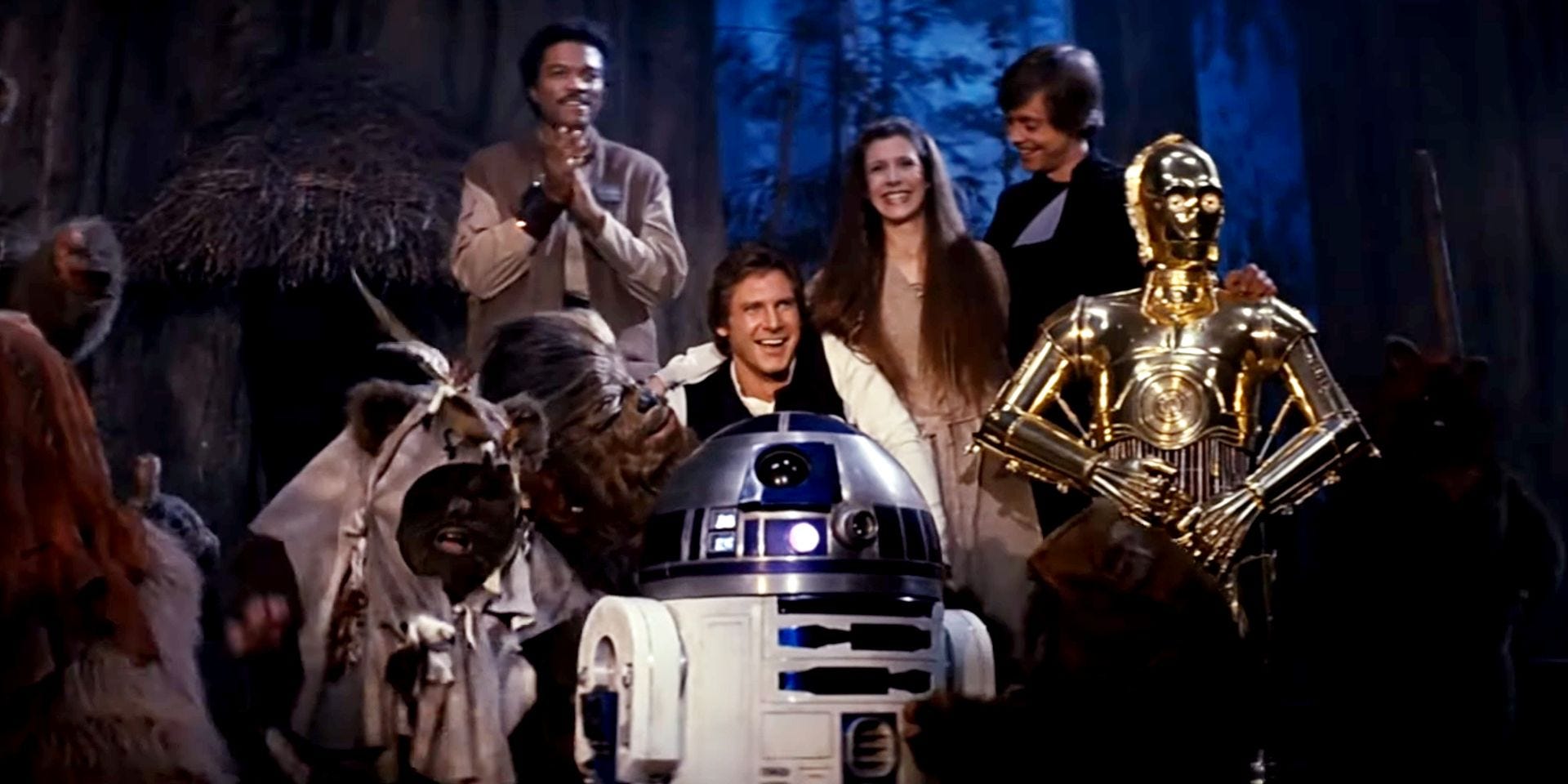
You cannot take the victory earned at the end of Return of the Jedi and simply cast it aside for things that happened off screen. It’s a violation of the Hero’s Journey structure, a betrayal of these characters, and a massive disservice to what amounts to a cultural institution.
The Squandering of Narrative Focus
Regardless, the opening of The Force Awakens serves its narrative function and introduces another character. Finn experiences an awakening of conscience. He refuses to fire upon helpless villagers, refuses to attend “reeducation,” and performs the first real heroic action of the film by rescuing Poe and helping to steal a TIE Fighter. He behaves like a protagonist. This would be a good job of introducing Finn if he was the hero of the film, except we have some more echoing to do.
Rey is the ubiquitous underprivileged kid from a desert planet. While Anakin dreams of freeing his fellow slaves and Luke dreams of doing something other than fixing droids all his life, Rey dreams of staying right where she is. She dreams of her parents coming back for her, but other than living a rather mundane life she appears well-adjusted. She’s a competent mechanic, scavenger and street fighter. She’s a likeable protagonist, but she has no discernible weakness. You could say it is her ignorance and naivete, but that doesn’t even so much as make her life uncomfortable. Her desire for her parents to come back is not a goal to pursue. She’s utterly passive.
Luke’s desire at the moment he accepts the Call to Adventure is clear: “I want to learn the ways of the Force and become a Jedi like my father.” Finn getting away from the First Order, or Rey getting back to Jakku, or Han avoiding his wife...those aren’t goals.
The only character whose goal drives the story is BB-8. He has to get the map to the Resistance. Finn agrees to help only so far as it aids his goal, Han Solo reluctantly helps because he knows Leia needs it, though he makes a clear effort to avoid going to her directly, while Rey is simply caught up in events.
This lack of narrative focus ruins any cohesive throughline the film may have had. Maz Kanata ends up filling the Obi-Wan Kenobi role for three different people: she challenges Finn to stay in the fight, challenges Han to get back in it, and challenges Rey to take up the lightsaber. Here, in the basement of her castle, Maz gives Rey her first lesson about the Force, what it can do and how she can access it. This is her Call to Adventure, and she rejects it. When Rey doesn’t take up the lightsaber, Finn does, except his dramatic moment is squandered as he has to be bailed out by Han Solo.
On Manufactured Drama
A word about the destruction of Hosnian Prime by Starkiller Base.
In Star Wars, the destruction of Alderaan did two things: One, it showed the destructive capability of the Death Star; Two, it showed how ruthless the Empire could be in pursuit of its goals. The emotional weight of the event on both Leia and Obi-Wan is immediately palpable and understandable. The viewer is never supposed to feel anything for the planet itself.
In The Force Awakens there is zero attachment for any character to Hosnian Prime, and therefore none for the viewer. It is not used as leverage to convince a prisoner to cooperate, there’s no emotional manipulation, and there’s no need to reveal to the viewer how bad it is that the First Order can destroy a planet. It simply repeats what came before at a mindless increase of scale with no immediate impact on the story. It’s played up for drama that doesn’t really work. Take out the destruction of Hosnian Prime and nothing in the film changes.
It’s not Rey’s Ability, it’s her Knowledge
When Kylo Ren captures Rey we are treated to a prolonged interrogation scene where he uses the Force on her, but given her native curiosity, internal strength and what Maz Kanata just got done telling her, she is able not only to recognize that Kylo Ren is in her head, but also discern a bit of his thought.
Remember, Luke’s only experience with the Force is one lesson Obi-Wan gives him where he “could almost see the remote.” Then in the final battle he is somehow able to use the Force to know exactly when to fire the torpedoes? Obi-Wan tells him: “This time, let go your conscious self, and act on instinct.” Qui-Gon tells Anakin: “Feel, don’t think. Use your instincts.”
The problem with Rey isn’t that she is competent and capable. We love competent and capable heroes like Jason Bourne or James Bond. The issue is that she is never really challenged. Nothing is made difficult for her. The problem isn’t that she can perform a mind trick on a mindless guard, but the fact that she even knows it’s a thing that she ought to be able to do. It’s in there because the viewer knows it’s something the Force can do, and therefore it’s no longer about serving the story but something outside of the story.
Then she’s somehow able to sneak around the interior of Starkiller Base with no advance knowledge of where anything is. While Finn aids Han and Chewie, he doesn’t even achieve his goal as Rey has rescued herself. Both Finn’s old desire to escape the First Order, and his new desire to save Rey are simply rendered moot rather than either overcome or fulfilled.
Misplaced Emotional Impact
Both Rey and Finn are passive witnesses as Han Solo completes his character arc in the film. Inexplicably, whatever emotional weight we have experienced throughout the film is suddenly realized in the character of the villain. Kylo Ren has been humanized by the two removals of his mask, and despite the desires of Bob Iger, J.J. Abrams, Simon Pegg and Kathleen Kennedy to pretend the Prequels didn’t happen, he represents the internal struggle of Anakin Skywalker, and we actually identify with him.
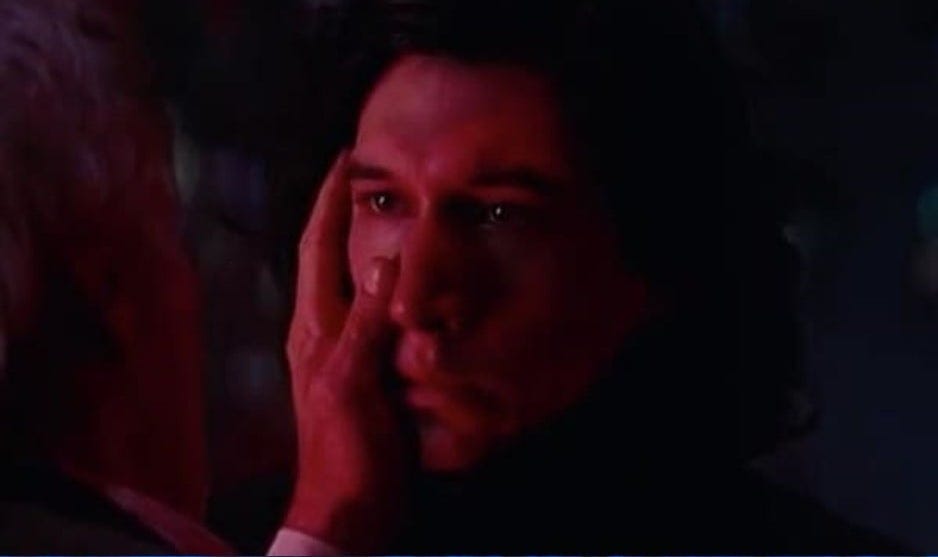
Knowing he is Han and Leia’s son gives us a point of emotional connection, something Darth Vader didn’t have until revealed as Luke’s father at the end of The Empire Strikes Back. Seeing Han confront Kylo we immediately gravitate toward the redemption of the villain because we’ve seen this story before. And of course, we want Han to live.
But when Kylo finally kills his father, and we see the touching display of affection from Han, there is so much emotional weight to what Kylo Ren is experiencing—that the viewer is sharing with him—that he becomes the most compelling character in the entire film. This takes all the energy away from the protagonists because they were never really established as protagonists in the first place.
Then we come to the face-off with Kylo Ren in the forest. When Rey summons the lightsaber, it’s a fun and dramatic reversal of our assumptions. But again, the problem isn’t that Rey is able to call the lightsaber in the Force—after all, the lightsaber called to her in Maz Kanata’s castle—it’s the fact that she even knows that telekinesis is a thing that she ought to be capable of. It isn’t that she had no training, it’s just she had no base of knowledge in the first place.
Where Rey’s Actual Knowledge is Used
On a related note, there’s been a lot of misunderstanding about Rey fighting Kylo Ren. As should be very clear, Kylo is interested in her potential in the Force. Finn was an obstacle, which is why Kylo dispatches him in short order. Rey became a goal. Kylo wasn’t interested in defeating her, he was interested in turning her. One must assume Darth Vader could have easily killed Luke Skywalker in The Empire Strikes Back, but it’s obvious why he didn’t.
Rey’s fight with Kylo isn’t a well-choreographed expert sword battle, it’s an injured and emotionally wrecked villain trying to manipulate someone who we already saw is capable of melee combat. When Kylo gains the upper hand he tells Rey: “You need a teacher! I could show you the ways of the Force!” Rey closes her eyes, as Maz instructed, and lets the Force in.
What follows isn’t a display of some unearned prowess in lightsaber combat, it is a protagonist trusting in the Force and catching the villain by surprise. Here, Rey isn’t using the Force for some action she logically has no idea is possible, she’s using the Force as instructed to amplify her physical ability and a skill which the storytellers have already established she is able to do.
Characters who are Completely Useless to the Story
In Star Wars, the protagonist is the heroic pilot who blows up the superweapon. Rey is even established as a pilot as she figures out how to fly the Falcon. Now, one must assume that as a scavenger and mechanic, she probably knows how to fly these things. Once again, the role of hero has been split and Poe Dameron gets Luke’;s role as the pilot. However, like the destruction of Hosnian Prime, you could remove Poe entirely from the third act of the film with no detriment to the story whatsoever.
Starkiller Base could be entirely destroyed simply by causing a chain reaction via sabatoge by Han and Chewbacca. There is no need to engage in an X-Wing attack on the Death Star—sorry, Starkiller Base—unless you are simply mindlessly echoing Star Wars and Return of the Jedi.
In the end, the protagonists of the film never experience any change. Rey has gained a skill, but has not overcome any weaknesses to do so. Poe is entirely unnecessary except for the very first scene of the film. Finn is also unnecessary because BB-8 found Rey on his own. Rey didn’t need Finn to run from the First Order as the troopers were after the droid. Rey didn’t need Finn to rescue her from Starkiller Base; that motivation could have easily fallen to Han Solo, or at the very least have Chewbacca suggest it. Finn even lies about being able to disable the shields, and they have to force Phasma to do it at gunpoint anyway! He serves zero purpose to the story.
Abandoning Opportunities and Promises
A character who could have served a purpose to this story, and arguably should have been in this film is Luke Skywalker. To return to “The Skywalker Saga” and not feature the Skywalker who began the whole thing, never mind not even reuniting the three principal characters of Star Wars, is a monumental waste of a once-in-a-lifetime opportunity!
Remember when I said the opening scene leads us to believe that the only way to save the galaxy is finding Luke Skywalker? Star Wars completes the loop from “get these plans to the Rebels,” to the Rebels using the plans to blow up the Death Star. Meanwhile The Force Awakens goes from “Find Luke Skywalker,” to destroying Starkiller Base without him involved! Once again, J.J. Abrams sets up a story promise he has no intention of keeping.
Take this quote from J.J. Abrams’ famous TED Talk featuring The Mystery Box:3
“The thing is that it represents infinite possibility. It represents hope. It represents potential. And what I love about this box...and what I realized what I sort of do, in whatever it is that I do...is I find myself drawn to infinite possibility and that sense of potential, and I realized that mystery is the catalyst for imagination.”
Establishing mystery and intrigue is a good way to keep viewers watching or readers turning the page. However, even an amateur screenwriter understands you do not create a mystery you have no intention of paying off. You don’t make promises you have no intention of keeping unless that’s planned out in advance with the follow-up writer, and as we all know now, there was no plan!
Here’s another quote from an interview J.J. Abrams gave to Collider, where he appears to pass the buck to someone who should have had a plan:4
“There’s nothing more important than knowing where you’re going...but having a plan, I have learned, in some cases the hard way is, you know, the most critical thing because otherwise you don’t know what you’re setting up.”
The Force Awakens is a weak and derivative story with far too many protagonists that ended up making the villain the most interesting character. But even that is not the worst sin. The victory earned at the end of Return of the Jedi is summarily discarded and the main characters of this important, modern cultural myth lost everything they had achieved by going back to weaknesses we had already seen them overcome.
It is simply an utter failure of storytelling from the very foundation. We just didn’t see it when the movie first came out because we were too busy being distracted by all the things that delight us about Star Wars. The creators behind the Sequel Trilogy thought they were making up for the supposed failure of the Prequels by giving the fans a movie that evoked the feeling they got from the Original Trilogy.
However, whether by intent or neglect, they ended up creating a mess of a film that disrespected the ending of the Original Trilogy, betrayed those beloved characters while creating new useless ones, and disregarded the basic building blocks of storytelling altogether.
J.J. Abrams, from the Star Wars: The Force Awakens Behind the Scenes Documentary
Lucas is infamous among the cast of the original Star Wars for this being his main direction, and it is useful as an in-joke for Star Wars fans, but does a disservice to George and his ability to direct. He was uttering this at a time when he was under a severe time-crunch from 20th Century Fox to finish the film, and was rushing between sets on a bicycle, so directing the actors necessarily required some shortcuts. However, it only serves to reinforce how much he trusted his actors to deliver.
Link:
Link:
Great read, thanks for the share. Is it rumoured that the creative team wanted to ignore the prequels or have they come out and said as much? What are your thoughts on TLJ?