


This is not an, “I left X because of my moral high horse” post. In fact, when it comes to my experience with this platform, the old saw, “It’s not you, it’s me,” is apropos.
On July 29, 2026, my experience with the platform once called Twitter finally came to an abrupt halt. After nearly twenty years of navigating my browser to the website twitter.com, I was suspended from the platform for something called “Inauthentic Behaviors.”
I’m not what anyone would have called a power user, and this isn’t the first time I’ve tried to quit the platform. I had already once again become convinced it was probably time to leave, and was reminded of all the good reasons to get off social media when some clips of Jaron Lanier, author of Ten Arguments for Deleting Your Social Media Accounts Right Now, once again crossed my YouTube recommendations.
How it Started
In 2006 I fell into the nascent world of Podcasting. Twenty years ago it was the ultimate hobbyist medium. The podcasting of back then feels like the Ham Radio of today. It was just people in their house building a following of fellow early adopters who loved the idea of finding like-minded people talking about the niche in which they were interested.
Slice of SciFi began as a fan effort to bring back Star Trek: Enterprise after cancellation. The show was founded by Michael R. Mennenga and Evo Terra, who hosted a local radio show on Sunday nights on KFYI in Phoenix called The DragonPage, where they would share interviews with such luminaries as Isaac Asimov, Ray Bradbury, Robert Jordan and George R. R. Martin. Once they dove into podcasting, they soon outpaced their listenership in the Phoenix area, easily into the tens of thousands of listeners.
Later, Evo Terra co-founded Podiobooks.com (now Scribl) with Chuck Tomasi and Steve Riekeberg, where they would host free audiobooks from authors who wished to harness the power of podcasting. The three earliest adopters of this technology for self-publishing were Tee Morris (MOREVI: The Chronicles of Rafe and Askana), Mark Jeffrey (The Pocket and the Pendant) and Scott Sigler (Earthcore). Tee Morris, along with Evo Terra and Chuck Tomasi, would go on to write Podcasting for Dummies, now in its Fifth edition.
The greatest beneficiary of this new mode of outreach was Scott Sigler, who would go on to leverage this into a contract with Crown Publishing, and became a New York Times Bestselling author with Infected in 2008. Sigler still releases a new episode of his podcast every Sunday, and has been doing so since 2005.
I say all this to point out the community aspect of the early days of podcasting. An entire ecosystem developed around the creation of audiobooks and radio-drama style productions, to the point that many of us performed guest voices in each others’ productions, and our voices went into the ears of many thousands of people. I was but a small part of this. Many listeners to Slice of SciFi produced comedy bits for its sister show, Michael and Evo’s Wingin’ It! I got on Twitter to follow all the people whose work I enjoyed, and in 2008 when I started hitting the convention scene, I used it to share and communicate with people I met and became friends with through this community.
How it’s Going
Twitter and Podcasting were beautiful things before the tech companies became giant monoliths who presumed to control the once-democratic and free Internet; before media conglomerates and celebrities harnessed the power of podcasting and the medium became corporatized and riddled with advertising.
Social Media used to be an organic mechanism whereby people shared things with their friends and made new ones. We used to see posts from people we follow in the order of time in which they were posted. Once the platforms began feeding us the posts that they wanted us to see, prioritized according to “engagement,” the real game was on. Because negative emotions rise faster than positive ones, that “engagement” is driven by negativity. If you wonder what happened to make our society less cordial and more cynical, social media amplified our baser instincts
Why have we seen the massive rise of cyberbullying? Because the would-be bullies who might otherwise be too cowardly to bully you to your face can now do so from a distance. Why the massive rise of youth suicide? Because the insular focus of social media combined with seeing other people’s most flattering presentation incubates envy, self-doubt and self-consciousness.
Social Media was never engineered to be the primary carrier for news or current events as presented by the traditional gatekeepers. It was intended for individuals to share what was happening in their personal lives. Inevitably, it got sucked into politics.
Once the tech giants colluded with the Federal Government to guide people’s behavior and censor information during the COVID-19 Pandemic, the mask fell off of the Social Media experiment, though an entire generation remains ignorant of the effect social media has on them. In fact, most of us are ignorant of the manipulation tactics that have been in place since the moment these platforms became public corporations, and slaves to shareholder value.
Elon Musk’s acquisition of Twitter has had mixed results. He immediately drove away most of the people I had become friends with through the once-small “podcasting community.” While many of them were more Left-leaning than right, not all of them left in a huff. Many of them simply slowly faded from the platform as they found less and less use for it, long before Elon Musk carried a sink into Twitter HQ.
Oh, Irony of Ironies!
One of the biggest kerfuffles Musk raised over the management of Twitter was the rise of automated bots. Ironically, one of the biggest problems on X has been the proliferation of automated bots. X has taken steps to reduce the presence of bots, such as the emphasis on verifying accounts, which is commendable, but if anything, X is the veritable home of “inauthentic behavior.”
Here is a list of those behaviors which I must have supposedly engaged in:
Unauthorized automation from third-party applications. I wouldn’t even know how.
Fake personas. Nope, not once. My persona is me.
Impersonation. Again, no.
Multiple accounts and coordination. I used to have a few other accounts for different purposes. I don’t go around liking my own tweets/posts.
Ban evasion. This is my first ban, so…no.
Content Spam. I don’t have time to do this. Look at my feed.
Engagement Spam (artificially impact traffic or disrupt people’s experience). Again, I don’t have that kind of time.
Scam tactics to obtain money, property, or private information. Nope.
Synthetic and manipulated media…that may result in widespread confusion on public issues, impact public safety, or cause serious harm. Other than a few AI-generated cover-type images many, many, many months ago? I’ve never caused confusion on anything.
Malicious URLs. The only links I’ve posted are YouTube videos or Substack links. Maybe they finally got me for linking people to Elon’s competition.
If you consider yourself even a semi-regular user of X, I defy you to look at that list and tell me you haven’t seen a multitude of accounts on X doing any of these very things! How many random likes do you get from accounts featuring some girl in a bikini? I’ve blocked more user accounts based on that action alone than anyone I’ve argued with on the platform. Because I know it’s likely not a real person behind the account. If it is, it’s clearly just an engagement farm or a glorified OnlyFans ad.
Just browse the “For You” section of your X feed and tell me how many posts you see that are clearly designed simply to get a rise out of you and get you to reply? How many posts do you see that are an obviously dumb take causing you to feel the urge to respond and correct them? How many posts do you see that are clearly designed to appeal to your political or societal values to get you to click the like and repost buttons? This is the most inauthentic behavior I can think of, and it’s all over every platform, because negative emotion drives engagement. That is the game the power users of X are conditioned to play, because that is the game the advertisers play. Engagement means money.
I’m Not Looking Back
I am no Elon Musk hater. I commend him for what he has done with Tesla and SpaceX. He has literally put his money where his mouth is in an effort to reduce our dependency upon fossil fuels, and make us a multi-planetary species. Does that mean I support every action he has ever taken? Of course not. But I am fascinated by iconoclasts of all stripes and what makes them tick. Every man who ever built anything of value to his fellow man was a complicated person. It takes a special kind of intense and discriminating focus to accomplish anything grand, and those sorts of people often hurt others on their way. Doesn’t make it right, just makes it reality.
Like Musk, the X platform hasn’t always dealt fairly with people. However, it has ever been this way. Twitter and Facebook did not play fairly with right-leaning users, X hasn’t really played fairly with…well, anyone. I see just as much engagement bait coming from the Left as I do the Right when I look at the platform. Just today I see as many posts saying, “Dr. Fauci saved millions of lives!” as those that say, “Fauci belongs in prison!”
If Musk can be blamed for anything, it is an over-reliance on automated systems to run his platform. I’m sure that either some disaffected user didn’t like something I said and reported me, and the automated system just went along with it, or the automated system just sucks. Either way, I’m not out anything. I guess it truly is the end of an era. We had a fun run, Twitter. But it really hasn’t been the same since maybe 2015.
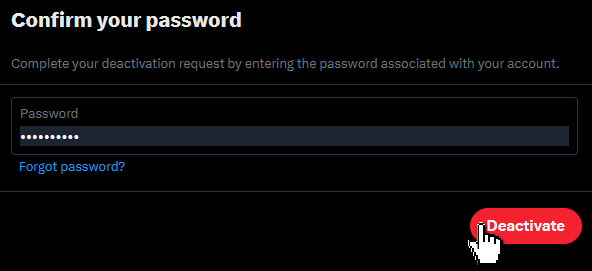
You know what the funniest part about it is? I can’t even deactivate my account. “Your account is suspended and is not permitted to perform this action.” It’s ok. In ninety days it will be deactivated for lack of use.
Goodbye, and good riddance.