He-Man and the Difference Between Sincerity and Seriousness
On nostalgia and a review of 2026's Masters of the Universe

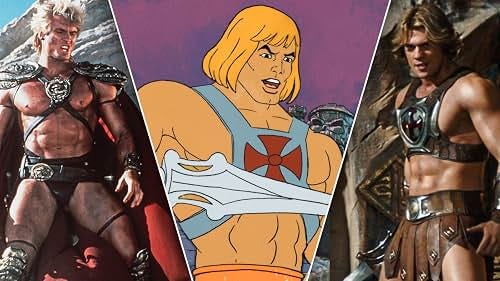
He-Man and the Masters of the Universe was never a serious show to begin with. It was full of puns, breaking the 4th Wall, and campy action where no one was ever actually hurt. What it did well, however, was approach the world and its stories with sincerity, not seriousness. It was a story for boys, about being a man with ultimate power, who yet restrained his power against his enemies, with compassion for the weak and a mission to help anyone in need. If you bear with this new version of He-Man, you’ll see the exact same theme revealed, though in a different way.
There is no need to make a “realistic” He-Man story. Its main villain is a man with a skull for a face, after all, who twists his metaphorical mustache and cackles with glee about being evil. 1987’s Masters of the Universe tried to make a more grounded Science Fantasy film, but deep in the 1980’s they couldn’t escape the trend to make it a portal fantasy connected to our current day, in the vein of Flight of the Navigator, The Last Starfighter or The Neverending Story.
They Tried This Before
I do have to comment on the 1987 film by way of comparison. Aside from Frank Langella’s appearance and the characters having the same names, there is not a single similarity to the original cartoon. The film always takes itself seriously. There is very little humor, no one outside of Langella or a very young Courtney Cox displays any personality whatsoever, and the Power of Grayskull is no more than a late magic-yourself-out-of-trouble card. There is no magical transformation; Dolph Lundgren is always He-Man, he is never anyone called Prince Adam.
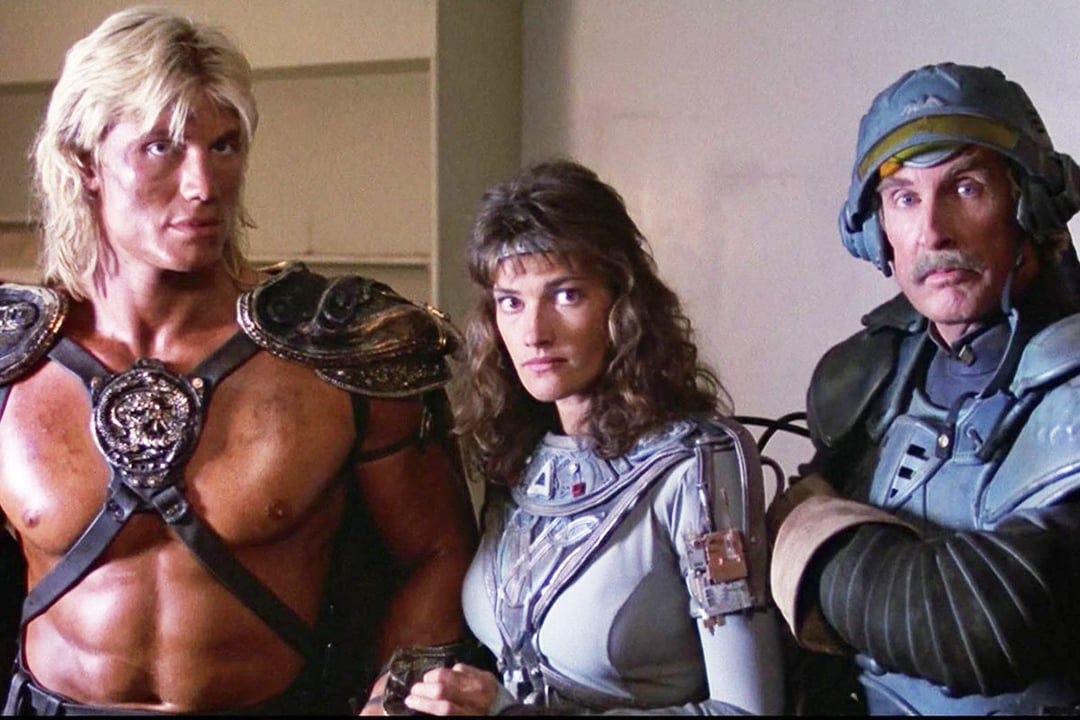
It is odd to think that an adaptation strayed so far from the source material at the absolute peak of it’s syndication run, but kids my age still flocked to the theater to see it. Even if we knew it wasn’t really He-Man, we still dutifully begged our parents to take us to see it. The filmmakers borrowed some of the trappings of a popular cartoon and made a sci-fi fantasy that resembled everything else to attract the “modern audiences” of the time, hoping to cash a very large check at the end of the day. It did not do well.
There have been some other abortive attempts to revive the property. The New Adventures of He-Man debuted in 1990 with 65 episodes that launched immediately into syndication. 2002’s He-Man and the Masters of the Universe was developed by screenwriter Michael Halperin, who had been hired by Mattel to develop the original series and lore for the toy line. They attempted to take the show a bit more seriously, even giving us a stupid origin story for Skeletor (a rival sorcerer named Keldor has his face melted with acid). They only produced 39 episodes.
In 2021, Netfilx released two different reboots of He-Man, one with disproportionate CGI-animated characters apropos to the era, and the one produced by Kevin Smith. About the only two notable things that can be said for Smith’s attempt is that it essentially made Teela the main character, and starred Mark Hamill as Joker playing Skeletor. It was literally the same voice. This series also took itself seriously, and once again the man playing Skeletor seemed like the only one having any fun. At least it featured a fantastic score by Bear McCreary.
A Nearly Perfect Blend
If I had to convey my thoughts on this film into anything digestible, I would say they just about nailed the balance of sincerity and camp in this movie, but for some fairly glaring flaws, it falls just short. Someone on X said that they “honored the source material.” I would say they “paid respectful homage,” but they didn’t quite honor it.
I never got the sense they were taking the piss out of He-Man, but they were getting us all to laugh at it just a little bit. Moments like this are where I was no longer watching a He-Man movie, but rather a Tribute-to-He-Man movie.
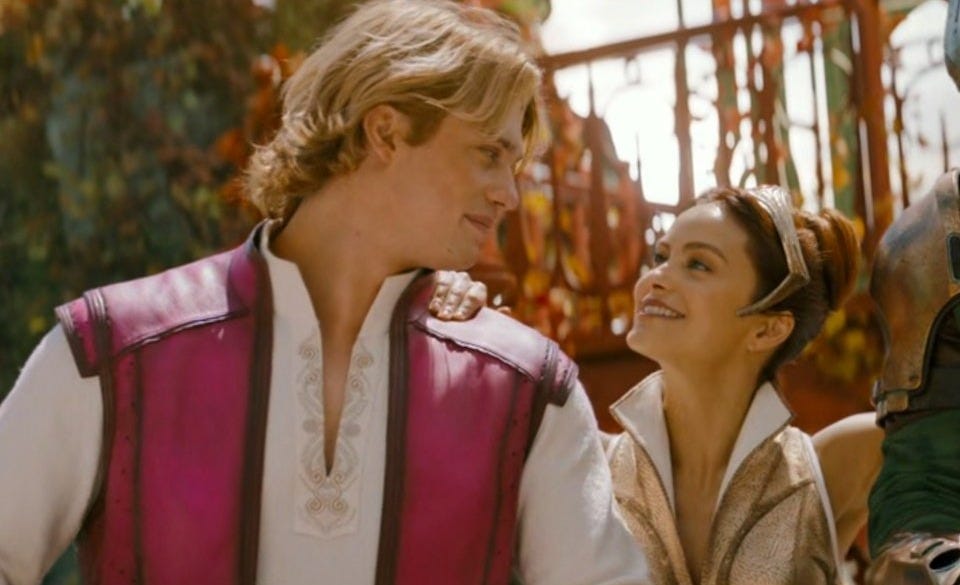
First, let me acknowledge where they got things right. The production design of this film is actually quite wonderful. My first impression on seeing the trailer was, “oh boy, more CGI slop.” But when you compare this to the aggressive pastels of the original cartoon and the persistent gloom of what passes for “modern” fantasy and sci-fi filmmaking, this is a breath of fresh air. The colors are vibrant. The costumes are similar but just different enough to be believable. He-Man’s fur briefs are replaced with a proper leather pteruges (armored skirt made of leather straps), but the chest harness is a perfect representation of the cartoon, and of course they nailed the ubiquitous sword.
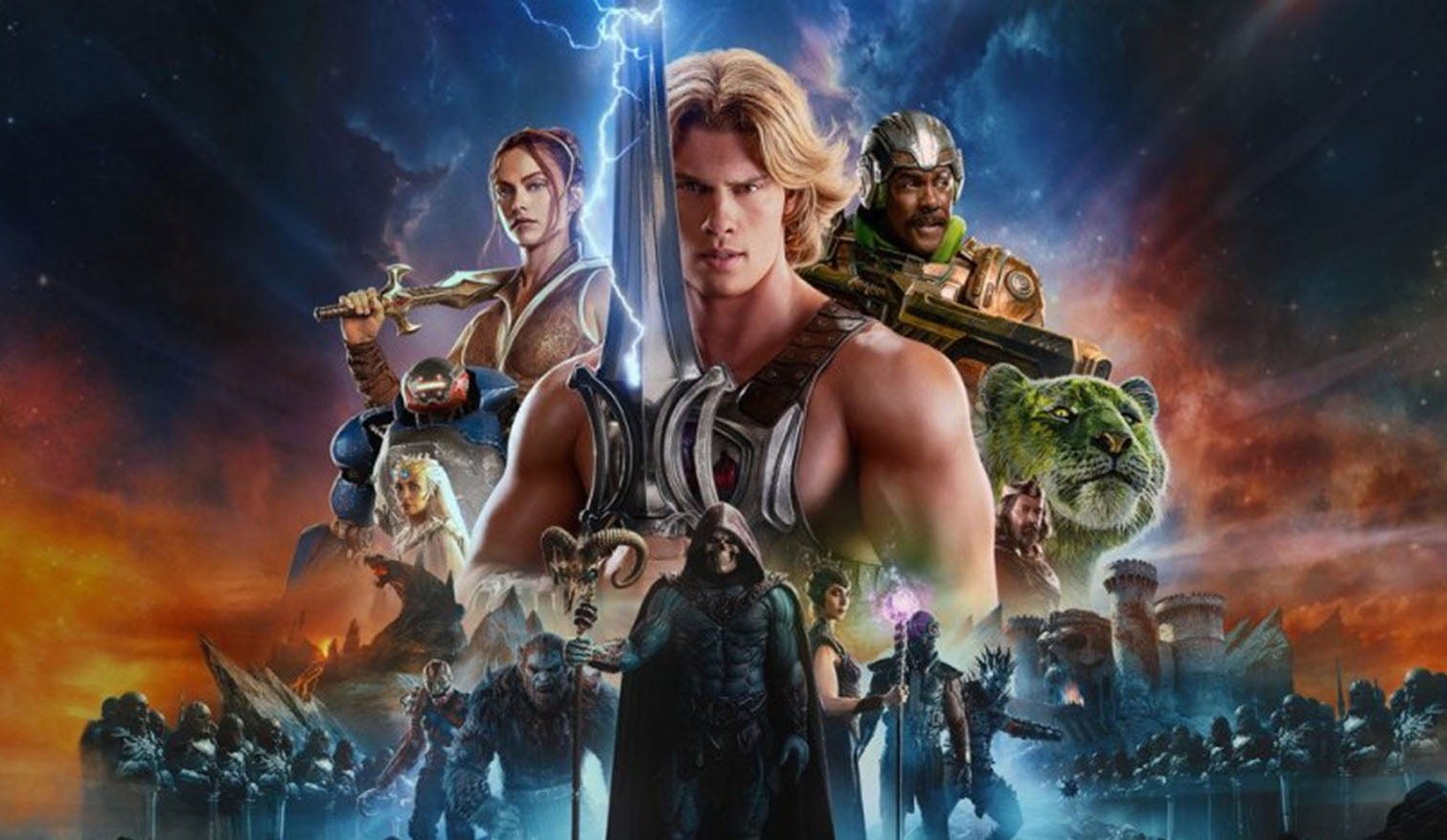
Nicholas Galitzine plays He-Man with an appropriate balance of camp and sincerity, humor and heart. He plays Adam’s naivete straight rather than as an act, though there is a drawback to this which I’ll get to later. Camila Mendes is a suitably athletic yet still feminine and believable Teela. Though I fear some might cry “woke” with changing Man-at-Arms from white to black, Idris Elba is actually perfect as Duncan. Jared Leto, for all his faults and controversies, disappears into Skeletor, relishing the role and lighting up the screen. I was also pleasantly surprised at the presentation of villains such as Trap Jaw, Tri-Klops and Beast Man. Even Cringer/Battle Cat was well done, though they dropped him from the transformation routine.
I do want to mention the post-credit sequences. They are short but meaningful, one of which sets up a potential sequel which at this point I hope they make because there is rich story ground there.
On Conceit and Suspension of Disbelief
The conceit of a film or story is the delusion you must appropriate to fully embrace the story being told. To accept Star Trek, you have to accept that five hundred years into the future, humanity is exploring the known universe with warp drive, phasers and transporters. To accept He-Man, you must accept that a man can hold aloft a magic sword, chant some words, and change into the ultimate action hero. Each imaginary universe has its own rules and constraints into which the story must fit.
This is where we run into the danger of taking things too seriously. It’s like the difference between 1989’s Batman and 1997’s Batman and Robin. The 1989 film was the right blend between gritty realism and comic book lunacy. The 1997 film put nipples on the Bat suit and had Arnold Schwarzenegger pun his way through two hours. Christopher Nolan’s Dark Knight trilogy effectively grounded Batman into our real world, but lacked any of the comic book camp.
2026’s Masters of the Universe takes the conceit just one step too far. As a story mechanic, exiling Adam to Earth with the sword to save both isn’t bad on the face of it. However, it is not in keeping with the original premise of the show. Yes, Adam’s mother is from Earth and crash-laned on Eternia, but everything within the show is from, and connected to, Eternia. Many times these fantasy stories are tied to our current Earth culture and setting because the storyteller thinks that will help the audience relate to the hero, but often it only serves to take the viewer out of the film, to remember they are watching something that isn’t really real.
The score of the film strikes the right tone for 80’s action cartoon music, but the inclusion of real-world songs again serves to take one out of the film one is watching. You are no longer in the story, but rather standing outside of it. It separates the viewer from the delusion they are supposed to be adopting.
Here’s a perfect example: a mild spoiler for the plot sequence, but gives nothing away.
At the launch of the Third Act, our heroes must execute a jailbreak. Pretty common trope for the formula this type of film follows. The team blasts their way through the stone surrounds of the unbreakable bars into a cloud of settling dust. They slow-mo march down the corridor as a good team of heroes do. This is another classic trope, played up for its effect. No one is taking this seriously. Then they go one step further. This march is not accompanied by dramatic underscore, but rather by Queen’s Princes of the Universe. A little too on the nose, that. What’s more, for the Gen-X viewer with nostalgic attachment to the property, this creates an inescapable connection to 1980’s Flash Gordon, another science fantasy connected to our own Earth featuring a soundtrack performed exclusively by Queen.
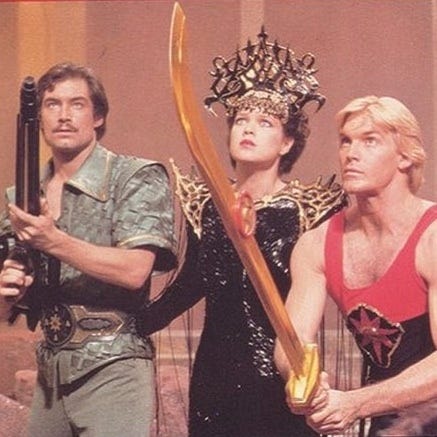
Then they take it even further. We get dramatic close-ups on Adam, Teela, Duncan and Ram Man. Even Fisto gets a close-up and this is where we go from camp to pure comedy. Fisto gives a dramatic hair toss like an 80’s shampoo commercial. Then the heroes start dramatically coughing from all the dust in the air, saying, “I can’t breathe,” and “I think I’m gonna be sick.” Fisto even hacks up some phlegm in slow motion. Then the fight starts.
They go from comic book camp into Mel Brooks/Monty Python-level farce, almost into parody. This is where they stop honoring the source material and turn it into a joke. A well-meaning and loving joke, but a joke nonetheless. Another example of this is at the end of the movie when Robot-O makes a joke, and they all laugh like the cartoon characters, hands on hips, bending backward at the waist in a full-throated belly laugh that is quite obviously forced. I never got the sense they were taking the piss out of He-Man, but they were getting us all to laugh at it just a little bit. Moments like this are where I was no longer watching a He-Man movie, but rather a Tribute-to-He-Man movie. It begins to lose sincerity and moves into absurdity.
The moment where the heroes escape and turn the tables on the villains is not treated with the sincerity of Bruce Wayne rising from the depths of The Pit, or the entrance of The Avengers when a beleaguered Captain America believes all is lost, or Daniel LaRusso rising from the mat and overcoming adversity to defeat Johnny Lawrence. It’s a music video setting up the final confrontation.
However, I’m not saying it didn’t work. It’s a fun and exciting sequence, it made me laugh, and it fits perfectly within the movie they decided to make. It just seemed to squander much of the energy of the character’s growth at a critical point in the story.
What I Didn’t Like
The worst part of the film is the use of language. I’m no prude when it comes to language in Hollywood movies, but every writing choice has a purpose. Obviously the cartoon was for kids, and it wouldn’t have passed the censors of the day in the first place. However, there is no purpose to the language in this film. It does not serve the viewer in any capacity, it does not “set a tone” or “fit a milieu” or any other sort of reason often given for cuss words in a film. Because this is based on a cartoon for kids, you would think they’d hew a bit closer to the innocence of childhood. Someone like my wife, who also grew up with He-Man and collected the toys, didn’t want to watch this anyway, and would be further incensed by the first utterance of “asses” from Man-at-Arms. Then there was Skeletor’s “shining sword dangling between your glorious thighs” which was just plain gross, and the constant double-entendre of Fisto “fisting people” was just downright unnecessary.
I initially refused to watch this film because I felt like it had that “for modern audiences” sort of vibe, and maybe this is a criticism of marketing rather than the film itself. However, the trailer’s reliance on highlighting the jokes and the “Adam actually lived on Earth” plot point turned me off of it. I think if they had emphasized the sincere heart of this film as a lighthearted action/adventure piece with a couple puns thrown in, it would have likely hooked me.
I also feel that the filmmakers squandered a golden opportunity to link this film with the original by using the theme song from the show. We don’t even get to any portion of it until the final scene before credits. This is a point of silliness that would have been appropriate for the film to use, and would have still lent it some heroic panache.
The Most Glaring Story Problem
Prince Adam is supposed to be Clark Kent, Bruce Wayne or Peter Parker. Often Adam is in the room when Randor says, “He-Man left before I got a chance to thank him.” Adam would then reply, “Don’t worry Father, I think he knows.” His secret identity as He-Man is one of the crucial story elements in the show. Skeletor may covet the power King Randor has in Eternia, but he knows he needs the sword to acquire it. Adam, Man-at-Arms and the Sorceress are the only people in Eternia who know who He-Man really is, and that is the point. Otherwise, Skeletor can use that knowledge as leverage over He-Man, which is exactly what happens in this movie. He even quotes the original show to Skeletor’s guards as He-Man: “I am Adam, prince of Eternia, and defender of the secrets of Castle Grayskull.”
Not only is this a departure from a central theme of the show, but this is what I meant about playing Adam’s naivete straight. He really is a rube who knows little about his own world, to the point he flashes his ID to Fisto to try and “prove” he’s Prince Adam. In the show, Adam pretends to be a coward who is unable to fight so that he can go transform into He-Man. In this movie he’s actually a coward who is unable to fight until he transforms.
A Weakness Becomes a Strength
This is where the film’s setup is secretly genius. It may not have been on purpose, but they show how a man may be emasculated by our current HR-run society, to the point he is an actual coward who only knows how to talk rather than fight the bad guys. In fact, this brings us full circle to the central theme of the original show, which I mentioned at the outset: a man with ultimate power who exercises restraint, and knows how to talk instead of fight. He doesn’t have to fight, but when he will when he must.
They still could have maintained his secret identity while expressing this theme. Not only do they let his identity be known, but they play up the secret identity thing for a joke at the end of the film. There is a distress call he must answer, and he says, “Well I gotta go take care of something.” As he leaves Fisto says, “Does he think we all forgot who he is?” Man-at-Arms replies, “Just let him do his thing.” Yes it’s funny, but not in keeping with the sincerity of the story.
In Conclusion
The state of theatrical cinema in 2026 is not like the way it used to be. The fate of Masters of the Universe may be closely related to 2023’s Dungeons & Dragons: Honor Among Theives. Had it played in cinemas in 2018, it likely would have been a hit. But people stopped going to the cinema after the pandemic. We all got far too comfortable sitting at home. The movie theater is not the communal experience we all used to share every weekend as a matter of course. It also doesn’t help that the theatrical experience has become far too expensive, and now all one must do is wait three weeks for the whole family to watch it on streaming for free. The movie studios have cut their own legs out from beneath them to keep people talking about their movie instead of paying an exhibitor actual money to see it.
This, more than anything, explains why the film bombed in theaters. Secondly, I don’t think the market environment favors the campy nostalgic revival, though after Barbie Mattel is really trying. Finaly, it’s a likeable enough film, but the marketing did it zero favors. They appealed more to a market demographic that has zero connection to the property, rather than the 45-55 year old Gen-Xers who grew up with it. Why not run a TV ad campaign featuring scenes from the film intercut with kids playing with the toys like an 80’s action figure commercial? Heck, just intercut it with an actual He-Man toy commercial!
This didn’t have to be a serious retelling of the He-Man story, ala Christopher Nolan’s Batman Begins, it just needed to be sincere. On that point I think it was 75% of the way there. I think the filmmakers sincerely love He-Man, I think the actors sincerely loved being in it, and I think it’s far better done than The Mandalorian & Grogu, or any recent Star Wars film.
I would wholeheartedly recommend watching it if you can accept something that pays tribute to He-Man without actually trying to “faithfully recreate it.” Because how do you faithfully recreate a pun-riddled pastel-plastered cartoon? However, you may have to appreciate a more modern camp style similar to Guardians of the Galaxy, though those films go a lot farther into farce than Masters of the Universe.
Ultimately I think the film achieves a good balance between sincerity and humor, with enough care for the source material that it still feels close enough to be worth watching.